It’s one application that runs the whole station, free and open source, and after weeks of testing on real stations it’s ready to stop calling itself a beta.
What it is: eleven modes in one program — FT8 and FT4 with WSJT-X parity, seven more WSJT-X modes, CW with a decoder and a keyer, RTTY, SSTV, and a phone cockpit— all sharing one rig, one CAT connection and one logbook. Plus APRS with a live
map, DX cluster and propagation, satellites, and a logbook that computes your DXCC, WAS, WAZ and grid awards on your own machine.
What it’s actually for:
You shouldn’t need four programs to work one band. Nexus owns the radio and hands it between modes, so switching from FT8 to CW to voice doesn’t mean closing things, fighting over a COM port, or re-entering the same contact twice.
When the radio stops answering, you should be told which part broke. Nexus names the fault — CAT, audio, or PTT — instead of going quiet, and picks the link back up on its own when the rig comes back.
You shouldn’t have to guess what’s worth working. Every station on the needed board carries its evidence: who heard it, when, and on what. A spot that’s three hours old says so.
Your log is yours. Awards are computed locally from your own contacts. No subscription, no cloud account, nothing phoning home.
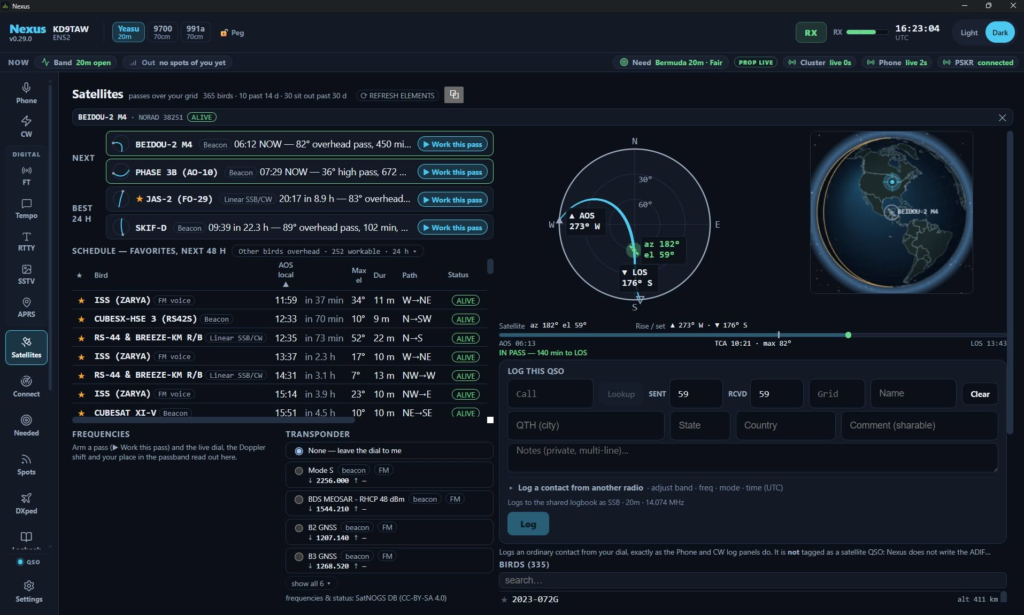
And satellites shouldn’t take a second computer. Pick a bird and Nexus corrects both legs of Doppler on its own, drives an az/el rotator, and works just as well if you turn the mast by hand — the sky dome puts azimuth and elevation on the
satellite itself so you’re not chasing a tooltip with both hands busy. The whole amateur catalog ships inside the installer, so it works on first launch with no network at all.
It runs on Windows, Linux (.deb and AppImage) and the Raspberry Pi, all signed, with an in-app updater. It installs per user with no admin rights and brings its own WebView2 and Hamlib, so it works on a locked-down shack PC.
The last stretch of beta was mostly satellite operating and rig-control edge cases — the kind of thing that only turns up on the air, reported by operators running it on their own radios. That work is done, and 1.0 is next.
If you tried it earlier in the year and set it aside, it’s worth another look.
Download: https://github.com/kd9taw/Nexus/releases/latest
Project page: https://hamradiotools.io/nexus/
Join us on our discord server for realtime conversation, feedback and input (Link on the project page)
73 de KD9TAW


Comments are closed